
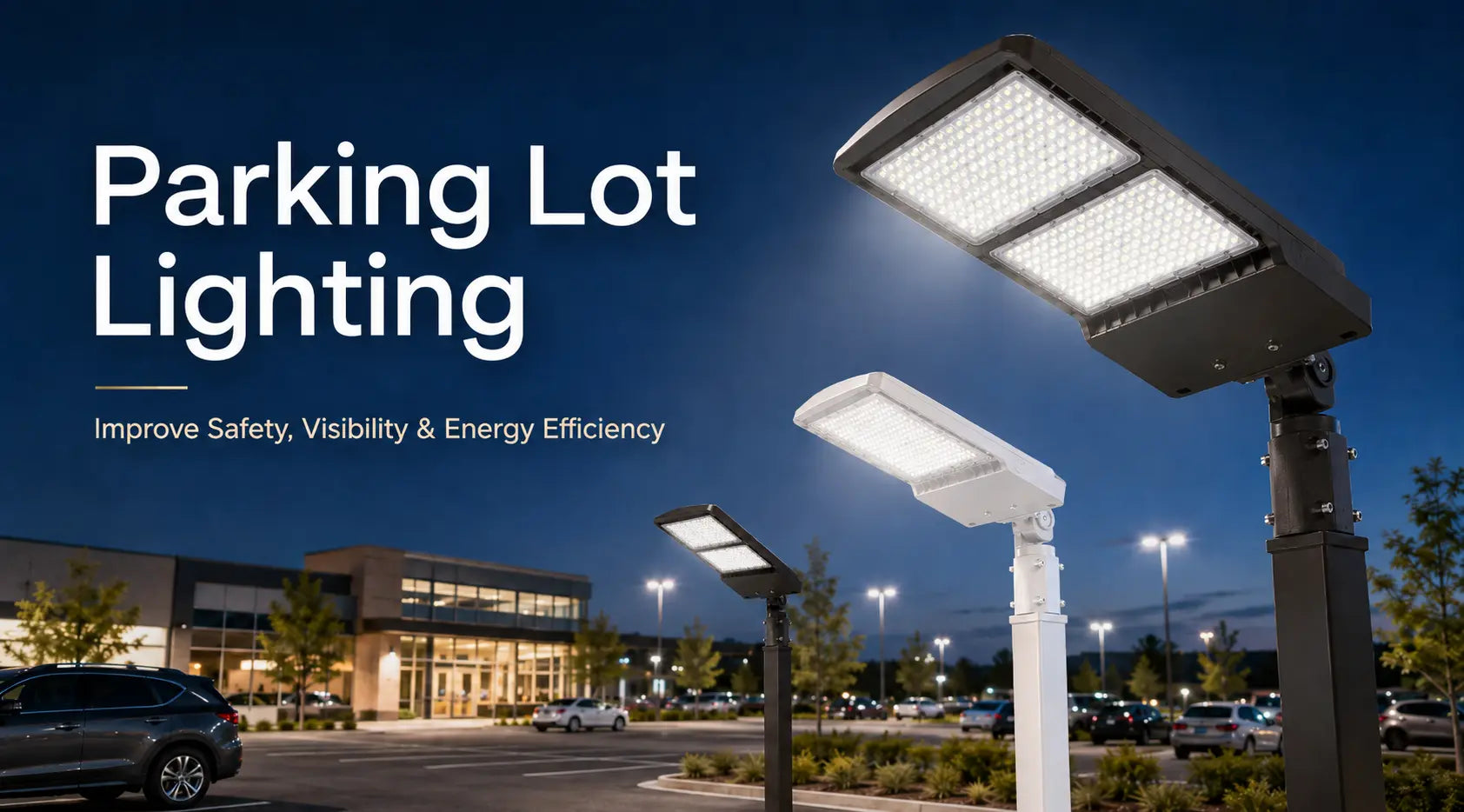
Parking lots look simple from a distance, but the lighting design behind them carries real responsibility. Good parking lot lighting helps drivers see lanes and curbs, gives pedestrians a clearer path, and makes a site feel safer after dark. It also shapes how a property is perceived from the street. The challenge is balancing brightness, uniformity, energy efficiency, and code compliance without over-lighting the space. The sections below break down what parking lot lighting needs to do, how standards are usually applied, and how to choose fixtures that fit the site.
What Parking Lot Lighting Needs to Do
The job of parking lot lighting starts with safety, visibility, security, and curb appeal. A well-lit lot reduces dark pockets where people can trip, helps drivers spot curbs and parked cars, and makes cameras more effective. Uniform illumination matters more than simply adding stronger fixtures, because even coverage cuts down on glare and harsh contrasts. That same consistency also supports traffic flow and wayfinding, especially in larger commercial and industrial sites where visitors may not know the layout.
Parking Lot Lighting Standards and Rules
What the rules typically cover
Most rules focus on brightness, uniformity, shielding, and spill control rather than the fixture label itself. A parking lot light can look impressive on paper and still fail if it throws too much light onto neighboring property or leaves uneven patches in the driving lanes. Local codes, zoning rules, and site-specific requirements can change the target levels, so compliance is rarely one-size-fits-all. In practice, lighting is evaluated by measured light levels and distribution patterns, which is why photometric planning matters before purchase.
Common lighting level targets
Typical foot-candle targets vary by lot size and risk level. Small, low-traffic lots often sit in a lower range, while medium lots and busier commercial sites call for more light and better uniformity. Higher-security areas, such as parking garage entries, perimeter zones, or late-night business parks, may justify stronger illumination and tighter control of dark spots. The safest approach is to treat published targets as starting points and confirm local compliance requirements before finalizing the layout.
What Is Parking Lot Lighting Called?
People use several names for the same basic category of fixture. Common terms include area lights, shoebox lights, parking lot lights, and LED area lights, usually referring to pole-mounted fixtures designed to spread light across a broad surface. Different industries may choose different labels, but the function is similar: wide coverage, controlled distribution, and reliable outdoor performance. In buying conversations, the name matters less than the mounting style, light output, and optic pattern.
Best Lighting for a Parking Lot
Choose LED fixtures first
LED parking lot lights are now the default choice for most projects because they combine energy efficiency, long lifespan, and lower maintenance. Compared with older HID options, LEDs deliver more consistent output and usually require fewer replacements over time. That matters on tall poles where service work is expensive. The best lighting for a parking lot is not simply the brightest fixture; it is the one that delivers usable light where people drive and walk, with stable performance in changing weather. For projects that need a reliable starting point, a white LED shoebox parking lot light can provide the kind of output and coverage many commercial sites look for.
Match light distribution to the site
Light distribution controls how coverage lands on the pavement, edges, and surrounding areas. A wide pattern can be ideal for open lots, while more controlled optics may fit narrow rows or properties near residences. The right choice depends on lot shape, pole placement, and traffic patterns, not on decorative style. For that reason, a led area light with the right distribution is usually more effective than a generic bright fixture. Spill control also helps reduce complaints from nearby buildings or streets.
Key Design Factors for Parking Lot Lighting
Pole height and spacing
Pole height changes everything about parking lot lighting design. Taller poles cover more area, but they also change the optics needed to keep light even and avoid hotspots directly under the fixture. Shorter poles may be easier to control but can require more units to cover the same lot. Spacing is a balancing act between uniformity, cost, and dark-area prevention. In many projects, the most efficient layout is the one that works with the site geometry instead of forcing a standard grid onto an irregular lot.
Mounting and installation details
Hardware affects both fit and aiming. An arm mount can extend a fixture into the correct position, while slip-fitter and similar mounts change how the light sits on the pole and how easily it can be oriented. Before ordering, verify pole type, fixture orientation, and attachment compatibility so the planned layout actually works in the field. That step is especially useful in retrofit jobs where the existing poles were not built for the new fixture body.
How to Select the Right LED Parking Lot Lights
Brightness, wattage, and light output
For modern fixtures, lumens matter more than wattage. Wattage only tells part of the story, while light output shows how much usable light the fixture produces. Selectable wattage can be helpful in design or retrofit work because it gives crews a way to fine-tune output after reviewing the site. The best approach is to size the fixture to the task, not to chase the highest number on the spec sheet. This is where led parking lot lights can outperform older products with better efficiency and less wasted energy. If you need a high-output option, a selectable shoebox parking lot light can be a practical fit for larger commercial areas.
IES files and photometric planning
IES files make it possible to model how a fixture spreads light before anyone buys it. That planning step helps reveal dark zones, over-lit areas, and spacing problems that are hard to judge from catalog photos alone. A photometric layout can prevent expensive over-lighting and reduce the risk of underperforming the final install. Facility managers and contractors both benefit because the design is based on expected real-world light distribution rather than guesswork.
| Selection factor | What to look for | Why it matters |
|---|---|---|
| Light output | Measured in lumens | Shows usable brightness |
| Distribution | IES files and optics | Controls coverage and spill |
| Mounting | Arm mount or slip-fitter fit | Ensures compatibility |
| Wattage | Selectable wattage if possible | Helps with tuning and retrofit work |
Color Temperature and CRI for Parking Lot Lighting
Choose the right color temperature
Color temperature shapes both appearance and visibility. Warm white feels softer and can suit sites near homes, while neutral and cool white are common in commercial and industrial settings because they often appear brighter and sharper at night. Cooler tones are popular for perimeter lighting and busy facilities, though they can feel harsher if the site sits close to residential areas. The right choice depends on the balance between visibility, comfort, and neighborhood context.
Why color rendering index matters
Color rendering index affects how clearly people, vehicles, and objects can be identified under the lights. A stronger CRI helps with facial recognition, vehicle color clarity, and security visibility, which is useful in lots where cameras and patrol checks matter. A practical CRI range around 70 to 80 works for many parking lot lighting applications, while higher CRI can be valuable where visual recognition is a priority. The goal is clearer detail without creating unnecessary cost or complexity.
Controls That Improve Efficiency
Photocells and motion sensors
Photocells automate dusk-to-dawn operation, which keeps parking lot lights on when needed without manual switching. Motion sensors can trim energy use during low-traffic periods by dimming or activating additional light only when activity is detected. Used together, they can lower operating costs while preserving safety. For sites with inconsistent nighttime traffic, this combination often delivers the best payback without changing the fixture layout.
Smart lighting options
Networked controls and dimming become more valuable when a site has multiple zones, changing occupancy, or strict energy targets. They are worth considering for larger campuses, garages, and facilities that already manage lighting as part of a building system. For smaller properties, the added complexity may not justify the upgrade. The best control package is the one that matches the site’s operating pattern and maintenance capacity.
Retrofit or New Installation?
A retrofit is often the simplest path when existing poles, wiring, and spacing are still in decent shape. Replacing the fixture heads alone can upgrade efficiency quickly, especially when the old system is using outdated lamps or costly maintenance parts. A full redesign makes more sense when poles are damaged, the layout creates dark spots, or the site has changed since the original install. If the property is expanding or safety issues keep appearing, starting fresh usually gives better long-term results. In those cases, a 150W LED parking lot light can be a strong option for moderate-scale replacements.
Parking Lot Lighting Maintenance and Compliance
Ongoing maintenance protects uniformity, safety, and energy savings. Cleaning lenses, checking controls, and confirming aiming keep light where it belongs instead of letting performance drift over time. As sites change, compliance can change too, so code checks should be repeated after fixture replacements or major property updates. A parking lot lighting plan is only as good as its upkeep.
Simple Parking Lot Lighting Checklist
Start with a code review, then define the layout, fixture type, and control strategy. Confirm pole height, light output, color quality, and mounting compatibility before ordering. For any sizeable project, use photometric planning and IES files to verify coverage and avoid guesswork. That short process saves time, lowers risk, and makes parking lot lighting much easier to evaluate with confidence. For larger electrical systems, a 277-480V selectable white shoebox light may be the right match when voltage flexibility matters.
Practical Next Steps for Better Parking Lot Lighting
The most reliable parking lot lighting projects are built around measured coverage, not assumptions. LED fixtures, sensible distribution, proper mounting, and basic controls usually deliver the best mix of safety and operating efficiency. For facility managers and planners, the smartest move is to compare the site’s actual needs against local requirements, then verify the design with photometric data before buying. That approach leads to fewer surprises and a better-lit property from day one. When comparing product options, a bright outdoor parking lot light can help support safety and visibility goals in straightforward installations.
Parking Lot Lighting FAQ
What is the standard lighting for a parking lot?
Standard parking lot lighting is usually based on foot-candle targets, uniformity, and spill control. The exact requirement depends on local codes, lot size, traffic volume, and security needs.
What are the rules for parking lights?
Rules for parking lot lights typically cover brightness, shielding, glare control, and light trespass. Always confirm local zoning and code requirements before finalizing the fixture layout.